


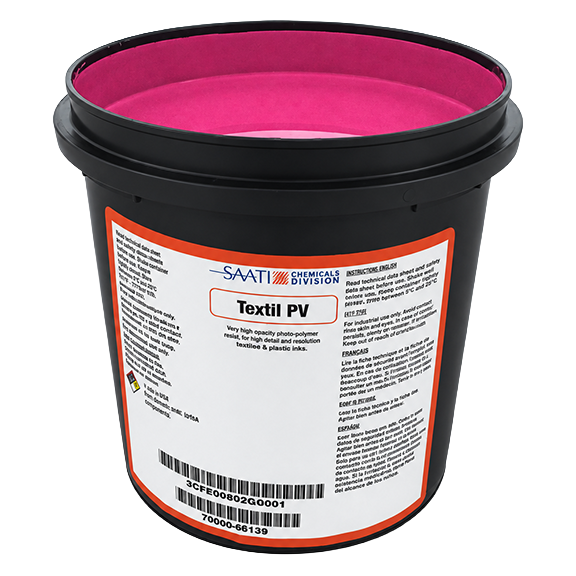
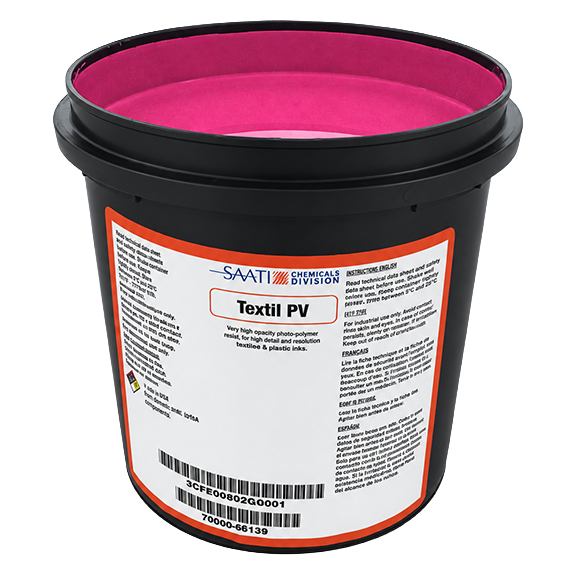
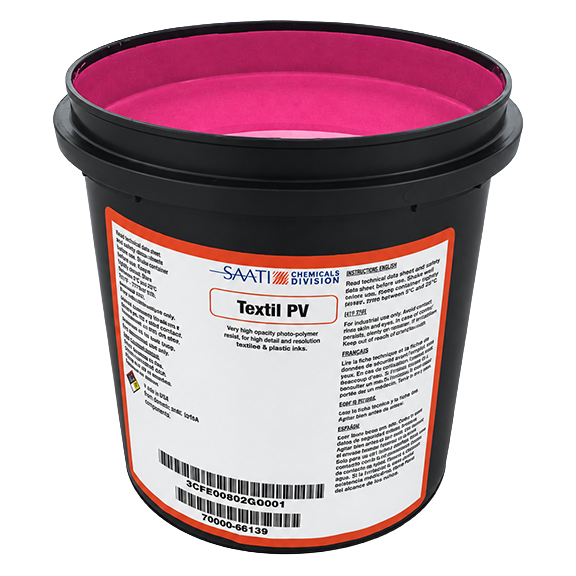
Saati Textil PV Pure Photopolymer Emulsion
Customize
Product Details
Saati Textil PV Pure is a fast, durable red photopolymer emulsion designed primarily for garment printing with plastisol inks. It exposes up to 8× faster than diazo or dual-cure emulsions and delivers tough, water-resistant stencils that hold up well on press.
This pure photopolymer formula is presensitized, so there’s no mixing and no diazo staining. With 42% solids and medium viscosity, it coats easily and bridges well across a wide range of mesh counts, making it a reliable choice for high-volume textile shops.
Key characteristics:
Red pure photopolymer direct emulsion resistant to plastisol ink, abrasion, and humidity
Exposes up to 8× faster than diazo or dual-cure emulsions
42% solids content and medium viscosity for easy coating and good bridging on many mesh counts
No mixing required and no diazo staining
Water resistant when post-exposed
Typical applications:
Garment printing with plastisol inks
High-volume textile and apparel production
Jobs requiring fast exposure and durable stencils
Directions for use:
Handle under yellow safelight or low-wattage tungsten lights. Avoid exposure to daylight, quartz/halogen lamps, cool white fluorescent lamps, or discharge lamps.
Sensitizing & mixing: Emulsion is presensitized during production; no mixing required.
Mesh preparation & degreasing: Thoroughly degrease mesh with Teknecal Degreaser TEK-405. Dry and store screens in a dust-free, dry environment before coating.
Coating: Using a high-quality scoop coater, apply 1–2 coats to the substrate side, then 1–2 coats to the squeegee side. For thicker stencils, add coats to the squeegee side before drying. For higher quality with minimal thickness increase, add 1–2 “wet-on-dry” coats to the substrate side after initial coats are dry.
Drying & storage: Dry coated screens at a maximum of 104°F (40°C) in a dust-free, dark or yellow-light area, substrate side down. Store coated screens in a dust-free, dry, safelight environment.
Exposing: Confirm exposure with a SAATI 21-Step Sensitivity Guide; a correct exposure holds 7 solid steps after developing.
Developing: Wet both sides with a strong, finely divided water spray and wash out until all image areas are fully open. Rinse both sides and dry thoroughly before use. A properly exposed and developed screen will not leave residues on the squeegee side.
Post-exposing: Post-expose the developed stencil with daylight or an exposure lamp to increase water and solvent resistance. This is especially effective for use with water-based or discharge inks.